
| Servings per container | 32 |
|---|---|
| Serving size | 1 oz. (28g) |
| Calories | 110 |
| Nutrient | % Daily Value* |
| Total Fat 1g | 1% |
| Saturated Fat 0g | 0% |
| Trans Fat 0g | |
| Polyunsaturated Fat 1g | |
| Monounsaturated Fat 0g | |
| Cholesterol 0mg | 0% |
| Sodium 0mg | 0% |
| Total Carbohydrate 20g | 7% |
| Dietary Fiber 3g | 11% |
| Total Sugars 0g | |
| Includes 0g Added Sugars | 0% |
| Protein 3g | 6% |
| Vitamin D 0mcg | 0% |
| Calcium 0mg | 0% |
| Iron 0.72mg | 4% |
| Potassium 94mg | 2% |
* The % Daily Value (DV) tells you how much a nutrient in a serving of food contributes to a daily diet. 2,000 calories a day is used for general nutrition advice.
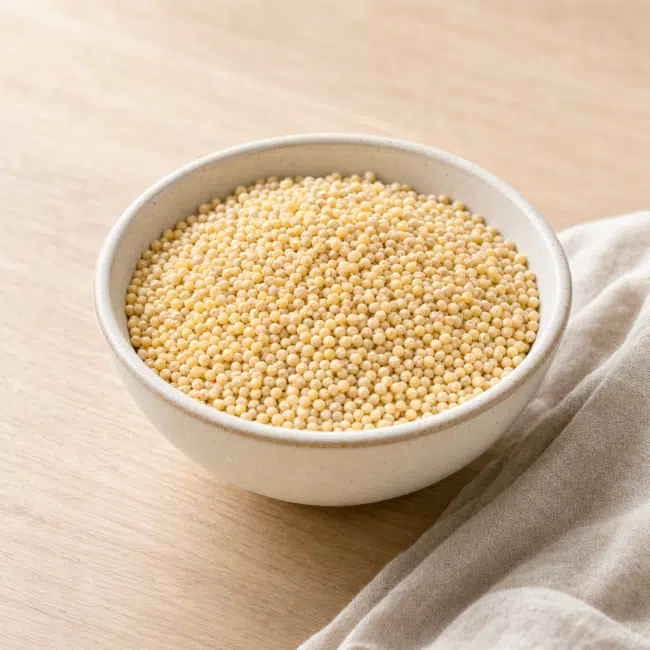
Ingredients: White Millet.
Price range: $12.99 through $24.68 — or subscribe to save 5%
White Millet Seed | Raw Grain
Skip or cancel anytime.
Free from the Top 14 allergens. Made on dedicated equipment. Allergen statement
Product Description
Gerbs White Millet is a single-ingredient, naturally gluten-free whole grain, guaranteed free of all 14 major allergens and processed on dedicated equipment that has never touched gluten, peanuts, tree nuts, or soy. Mild, slightly sweet, and quick-cooking, it is a versatile base for breakfast porridge, fluffy pilaf, and baking, with none of the cross-contact worry that comes with grains packed on shared lines.
Ingredients
Whole White Millet.
Allergen Declaration
Free From: peanuts, tree nuts, milk, eggs, gluten/wheat, soybeans, fish, crustaceans, mollusks, sesame, mustard, celery, lupin, and sulfur dioxide/sulfites.
All raw ingredients are processed, packaged, handled, stored, and shipped by trained staff in our family owned & operated facility in Johnston, Rhode Island on dedicated kosher-certified equipment. No co-packers. No co-manufacturers. For anyone with a mild to severe food allergy or a family with one, we wish to assure you that this is why Gerbs handles all aspects of production & operation. If you have any questions about your allergy and our products, please contact us at [email protected] or (401) 231-5181 before ordering.
Flavor & Texture
White millet has a mild, slightly sweet, faintly corn-like flavor that takes on the seasonings you cook it with. Its texture is the real appeal: toasted and cooked with less liquid, it turns light and fluffy like couscous; simmered with more liquid, it becomes soft and creamy like porridge or polenta. The little grains have a gentle, tender bite with none of the heaviness of denser grains.
Storage Recommendations
Store uncooked Gerbs millet in an airtight container in a cool, dry pantry away from heat, moisture, and direct sunlight, and reseal the bag between uses. Stored dry, whole millet keeps well for up to a year. Cooked millet should be refrigerated within two hours and used within 4 to 5 days, and it also freezes well in airtight portions for quick future meals.
Key Health Benefits
Gerbs White Millet is a clean, single-ingredient whole grain with a lot of everyday flexibility.
Naturally Gluten-Free
Millet is naturally gluten-free, and Gerbs millet is processed on dedicated equipment that never touches gluten or wheat. For anyone avoiding gluten or managing celiac disease, it is a versatile, allergen-safe grain.
A Whole Grain
White millet is a whole grain, a category the USDA Dietary Guidelines recommend making up at least half of total grain intake for its fiber and nutrient contribution.
Source of Plant Protein
Millet provides plant-based protein, making it a useful base grain for vegetarian and plant-forward meals, especially when paired with seeds or legumes.
Mild and Easy to Digest
Its mild flavor and tender texture make millet an approachable grain that many people find easy to digest, which is part of why it has been a global dietary staple for so long.
As with all foods, individual results may vary. Gerbs makes no medical claims.
What Is Millet?
If you are looking for a naturally gluten-free grain that is easy to cook and gentle on sensitive systems, millet deserves a spot in your pantry. Gerbs White Millet is a single-ingredient whole grain, guaranteed free of the 14 major allergens and processed on dedicated equipment that has never touched gluten, peanuts, tree nuts, or soy. Mild, slightly sweet, and quick-cooking, it is a versatile base for everything from breakfast porridge to fluffy pilaf, with none of the cross-contact worry that comes with grains packed on shared lines.
Millet is one of the oldest cultivated grains in the world and a staple across Africa and Asia, yet it is still underused in American kitchens. Grown in the United States, Gerbs white millet cooks up tender and fluffy or creamy and porridge-like depending on how much liquid you use, which makes it remarkably flexible. Gerbs cleans and packages its grains in small batches in our family owned and operated facility in Johnston, Rhode Island, with no co-packers and no shared lines. Naturally gluten-free and easy to digest, it is a dependable everyday grain backed by the Gerbs Guarantee.
Millet is a small, round, ancient whole grain, naturally gluten-free and one of the oldest cultivated cereals in the world. White (proso) millet has a pale golden color, a mild and slightly sweet, corn-like flavor, and a tender texture that turns fluffy or creamy depending on how it is cooked. It has been a dietary staple across Africa and Asia for thousands of years. Because it is a true grain rather than a seed mix, millet works as a one-to-one stand-in for rice, couscous, or quinoa in most recipes, while being gentle and easy to digest.
How to Cook Millet
Millet is quick and forgiving on the stovetop, and toasting it first brings out a nutty flavor.
- For a fluffy result, toast 1 cup of millet in a dry saucepan over medium heat for about 5 minutes, until golden and fragrant.
- Add 2 cups of water or broth and stir; raise the heat to high and bring to a boil.
- Lower the heat and simmer, covered, for about 15 minutes, until the liquid is absorbed.
- Remove from heat and let it rest, covered, for 10 minutes.
- Fluff with a fork and serve. For a creamier, porridge-style millet, use 3 cups of liquid and stir occasionally as it cooks.
Use cooked millet as a base for bowls, fold it into salads, shape it into patties, or serve it warm as a breakfast porridge.
WARNING: California Proposition 65
WARNING: Consuming this product can expose you to chemicals including lead and cadmium, which are known to the State of California to cause cancer and birth defects or other reproductive harm. For more information go to www.P65Warnings.ca.gov/food.
FAQ
Is millet gluten-free?
Yes. Millet is naturally gluten-free, and Gerbs millet is processed on dedicated equipment in our Johnston, Rhode Island facility that is free of gluten and wheat, with no shared lines and no co-packers, so there is no cross-contact.
What does millet taste like?
White millet has a mild, slightly sweet, corn-like flavor that is far less assertive than grains like quinoa or buckwheat. Because the flavor is gentle, it readily takes on the seasonings, broths, and sauces you cook it with, which makes it easy to use in both savory and sweet dishes.
How do I keep millet from turning mushy?
Use less liquid and toast the grain first. Toasting 1 cup of dry millet for about 5 minutes, then cooking it in 2 cups of liquid, gives a fluffy, separate texture. If you want it creamy like porridge, do the opposite and use about 3 cups of liquid with occasional stirring.
Can I use millet in place of rice or quinoa?
Yes. Cooked millet works as a one-to-one substitute for rice, couscous, or quinoa in most bowls, salads, and sides. Its mild flavor makes it an easy swap, and it is naturally gluten-free like quinoa and rice.
How should I store millet?
Keep uncooked millet in an airtight container in a cool, dry pantry away from heat and moisture, where it stays fresh for up to a year. Cooked millet keeps in the refrigerator for 4 to 5 days and freezes well in airtight portions.
Frequently Bought Together
Related products
-
Gluten-Free Instant Oats | Whole Grain
Price range: $20.99 through $39.88 — or subscribe to save 5% -
Buckwheat Groats | Raw Seed
Price range: $12.99 through $34.18 — or subscribe to save 5% -

All Purpose Flour | Gluten-Free
$12.99 — or subscribe to save 5% -
Black Rice | Whole Grain
Price range: $15.99 through $44.99 — or subscribe to save 5%
Customer Reviews
You must be logged in to post a review.
Shop by Category
Find Your Safe Favorites
Seeds
Dried Fruit
Snack & Trail Mixes
Granola
Grains
Reviews